



Notes
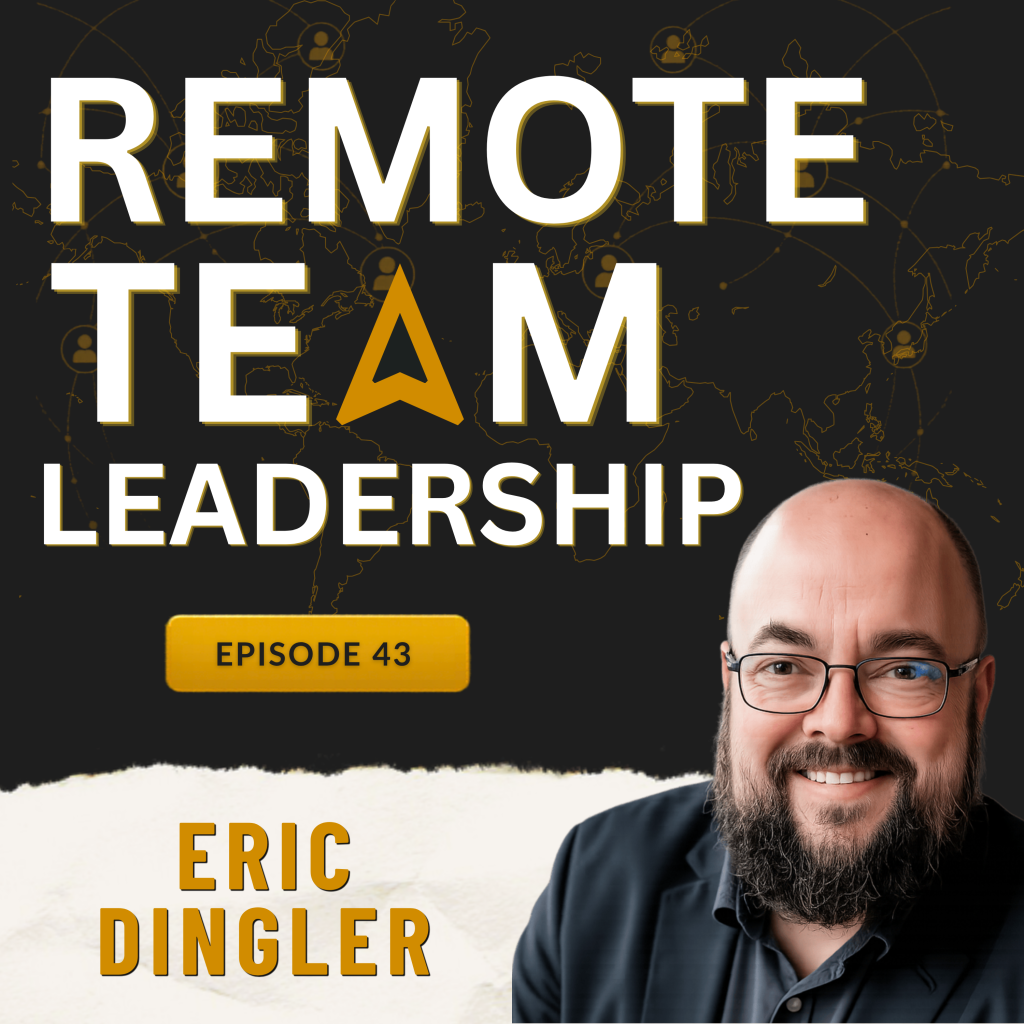
This is the episode where the Digital Nomad Entrepreneur Podcast became the Eric Dingler Leadership Podcast, with its focus set on building and leading a remote team. Eric explains why: leadership is the one thing that has stayed constant across 30 years of his work, and your leadership capacity is the capacity of your business. Then he gets practical. A week after an accessibility training told him he’d probably never be asked for a VPAT, a client asked for one. Nobody on his team could build it, and he said yes without hesitating.
Eric explains where that confidence comes from: 15 years of hiring 30 to 40 summer camp staff a year, then years of hiring for other organizations and his own agency, adding up to more than 10,000 hours of interviewing. He walks through the process step by step. He wrote a clear statement of the final product and a job description for a single task, messaged two Upwork freelancers with the exact same questions for an apples to apples comparison, planted test questions, and used drafting the scope of service as a test task to check their detail and communication. After one interview he split the contract into three milestones funded through escrow. Both candidates quoted a week for milestone one, so he told the client four. The freelancer cost about $2,000, and the market supported an $8,000 price for the client.
He also draws a hard line between technicians and owners (“real estate agents don’t build the houses they sell”) and introduces the 90 day Team Engine Accelerator. The leadership tip of the week comes from how his remote team sets its own hours: support staff still check tickets at 9, 1, and 3:30 Eastern. If you want the privilege, own the responsibility.
Key Highlights
- Systematize for success, because a tested hiring process is what lets you say yes to work you can’t do yourself.
- Start every hire with a clear statement of the final product, since vague outcomes produce vague hires.
- Ask two candidates the exact same questions and give them a test task so you’re comparing apples to apples.
- Real estate agents don’t build the houses they sell, and you can’t grow a business by staying the technician.
- If you want the privilege, own the responsibility.
Key Takeaways
In this episode, you’re going to discover how to hire amazing people who are going to help you find more fulfillment from your work and help ensure that your business grows. Welcome to the podcast, everybody. My name is Eric Dingler. I’m your host, and this is a lot for one podcast episode. I’ve got an announcement I want to share. It’s not a big thing. I’m just going to quickly share with you an announcement, and then I want to talk through hiring. We’ve done a few episodes in the past about it, but I’ve recently just hired another person, this time a freelancer, for a very specific project that I’m making a very huge profit margin on. And as I was sharing this with some of my coaching clients, they were really kind of curious to learn more about the process that helped me be so confident in promoting this and taking on this big client, this big project that I literally have zero skill set in delivering the final product. Now the final product aligns with our business. It’s a perfect complement to what we do. But I don’t know how to do it. Nobody on my team does. And my coaching clients wanted to know again, how did I have so much confidence? Was it pride, which, if you’ve been a long time listener of the show, you know I admit I can struggle with pride and arrogance, but it’s really not. This time it is from experience, and so I’ll share that. And then I’ve got this week’s leadership tip of the week, and then a travel update for those of you that like the travel side of our lifestyle.
And that kind of brings me to our big announcement. So just real quickly, because I know some people tune in, and you’re not tuning in because of the travel stuff. I’ve heard you, and so listen, because this applies to you. So we have decided, by we I mean my wife and I, along with our kids’ understanding, that the time has come for us to settle down. We’ve been traveling for over three and a half years. By the time we settle, it will be almost four years. So we’ll have spent four years traveling around the world with our kids. We’ve got a few more countries to go, some things to wrap our time up. But it is time for our family to settle down. We need to do this for really personal reasons, to help our kids transition a little more smoothly into adult life, into young adult life and independence. And who knows, maybe in the future my wife and I will pick back up our location freedom lifestyle. We’ll be able to if we choose to. But for the next season anyways, we’re going to start settling down. We don’t know where yet. We have no idea. Those are details. The big decision was just to settle. So now that we’ve made that, we’ll figure out where.
Now, how does that connect to the podcast here? Well, I’ve decided to rebrand. And so you’re going to notice that the podcast is going to be changing from the Digital Nomad Entrepreneur podcast to, very simply, the Eric Dingler Leadership Podcast. And here’s why I’m going to transition to this. I’m entrepreneurial. I change my focus. I change a lot, my interest and what I’m doing and how I’m doing it and what I’m learning, and even my passions. But the consistent thing over the years, over the last, you know, thirty years, the thing that’s been consistent is leadership. Every single thing I do, it is, at its core, leadership. And if you’ve listened to any podcast in the past, you’ve probably heard me say I wanted to start a leadership podcast, but there was already plenty of them out there. And I finally just decided, you know what, I don’t care. I’m doing this because I’ve got a unique voice in the leadership space. I’ve got unique experience. It’s not better. It’s just unique. It’s different. And there’s an audience of people out there in the world that connect with it, that want to hear from it, that learn from it. And so I’m going to make this podcast for you and for me, for right now and for a while. It’s been this way, and for a while it will continue to be this way, I’m sure.
But for right now, I’m talking specifically about how to build and lead a remote team. Now, on the digital nomad entrepreneur side of things, I kept also trying to talk about some of the business side of things and stuff like that, and that’s all good and great. But honestly, that’s the boring side of things for me. I connect with and I love the leadership side of it. It’s all because you’re never going to go beyond your leadership capacity. Your leadership capacity is the capacity of your business, your nonprofit, your church, whatever it is you’re leading, even your family, even yourself. Leadership is the capacity. And so I’m just going to keep talking about leadership. And the reason I’ve decided to just call it the Leadership Podcast is because I’m not trying to create an asset or a brand to sell or anything like that. I have the heart of a teacher. I love to teach. I’ve always loved this from being a camp director. I tell people all the time, I was a camp director for fifteen years, and the thing I miss the most is staff training, staff development. I loved the two weeks of staff training. I also enjoyed all the retreats throughout the year. I enjoyed every morning starting my day at morning watch in the outdoor chapel with the campers, morning after morning sharing a message to help them get started on the day, and speaking at Vespers in the evening. I miss the coaching. I miss that teaching. I miss most the teaching of the staff, developing the staff, the leadership development of the staff, and then pastoring. I loved preaching on Sundays and teaching at special events and things like that. But I miss developing the leaders the most out of that.
And with my business, growing my business, I enjoy the business side of it, but I love when we deliver a service, a product. It’s the teaching that fires me up. And so I’m just going to make this the Eric Dingler Leadership Podcast. And if I decide down the road that I want to talk specifically for a season about church leadership, well then I’ll just change the subtitle. But for right now, for this season, I’m talking building and leading a remote team. So plug in, engage. If you are someone that wants to build a remote team sooner in the future, if you already are trying to lead a remote team and you want to do it better, this could be hybrid too. Now, obviously the things I talk about get applied everywhere because leadership happens everywhere. A leadership principle that works in the workplace works at home, works in parenting, works in marriage, works in volunteering. Leadership happens everywhere. Leadership principles are universal. If you hear something and you’re like, well, that may work in business, but that won’t work in my family, that’s management. That’s management. Leadership is universal. So if you hear a lesson, and you’re like, wow, I can see that in my own life, in my marriage, my parenting, at work, in volunteering, coaching the Little League team, that’s leadership. And so I want to talk about that, and I’m pivoting the podcast to that. So if you’re someone that wants to grow your leadership, make sure you keep listening. So welcome to the rebranded Eric Dingler Leadership Podcast. My name is Eric Dingler.
So today, what do I want to talk about today? I want to talk about specifically hiring a team, hiring a person. This could be a freelancer. It could be a member of your team. But I want to talk through the process, and then I’m going to give a very specific leadership tip of the week and wrap things up with a really fun travel update.
So I want to start out by sharing this story with you, kind of where we are. So several weeks ago, I took a five day challenge to learn about adding and implementing better accessibility processes and accessibility services to our agency. I own a web design and digital marketing agency. And as I am trying to figure out how to pivot and respond and adjust to the ever changing landscape that AI is bringing into things, we’re trying to figure out what our place is going to look like in the marketplace moving forward. And we’ve decided that we want to land and live in the place of working with local business owners who are coachable and that want and need a marketing strategy and system that is built with accessible content. We want to work with people that understand and agree that content online, that people should have equal access to that regardless of their ability and disability. And it makes sense for us to be here because we believe in this. I’m legally blind, and so I understand a little bit about the struggle that some people have with accessing content online. I’ve got a lot to learn, but I want to live into that space a little bit more with our agency. And so what we’ve decided to do is pivot to this, add some of these services into what we do.
During this process I learned what’s known as an ACR. This person, Jen, that I was taking her five day thing, she’s absolutely phenomenal. She’s sharp. She knows her stuff. I’ll link to her resources and training in the show notes. But Jen is absolutely, I think she’s absolutely brilliant in the world of accessibility and anything compliance wise as it relates to website and digital content. And it was interesting. One of the things that she said, she was training us, teaching us the different levels of accessibility, is there’s this one thing it’s called a VPAT. It’s this form, and when it’s filled in, it creates what’s called an ACR, an Accessibility Compliance Report or Conformance Report. I can’t remember what the ACR stands for, but she said you’re probably never even going to be asked for this. This is like top of the level, really high. Like, this is something that the big dogs need in the space. Very seldom is this required. And she’s like, so I wouldn’t worry too much about it. Well, about a week later, one of our clients reached out and says, hey, I need a VPAT. Can you guys do that? And I’m not going to get into why he needed it, but he needed it. And without hesitating, I replied back and said, yeah, absolutely, we can do that. Let’s, give me some details. What do you need it for? When do you need it by? Give me the details. And so he shared the details with me. And this is something that is very technical, and nobody on my team, I can’t do it. It is way, way above us.
Now, I didn’t panic. I didn’t stress. I knew exactly what I wanted to do. I have a system. I have a process that I’ve honed over the years to find great team members. You’ve got to remember, for fifteen years I ran a summer camp, and every summer we had to hire staff. And so I would need to hire, you know, thirty, forty staff a summer. And so I had to do a lot of interviews. And every summer, at the end of the summer, all that staff left, and I got to sit back and go, who worked out? Who didn’t? What was the process? How did I recruit them? I want to repeat that process. How did I recruit them? Because I don’t want to ever do that again. I don’t ever want another one of those people on my team. And so each year I got to evaluate this and try again the next year. And it just got better and better and better. And then when I transitioned to the local church, I had to hire people for the church. And then in my company. And I figured this out the other day, and I have spent well over ten thousand hours interviewing and hiring staff. And then beyond that, all the onboarding and training and development. So I really have, over the years, crafted this process that works.
And I know when I talk to people, and I’m like, oh, you should go hire someone, go hire a freelancer, I hire off of Upwork, I hear horror stories. I can’t get over how many times people have told me stories about getting ripped off, or hiring somebody and not getting what they want and the quality being poor. And I have to be honest, that’s just not happened to us in the last several years now, because we hire, we hire a lot, but because we have a process. We’ve learned to systematize for success. Systematize for success.
And so I immediately went into the process. I didn’t even consciously think about, okay, what do I need to do now? It just was habit, and I went through the process and I found someone, and I worked with them to build a quote, because I was just honest and said, I’ve never done this before. And I’ve talked to two people, they didn’t know I was talking to two people, but I kept the conversation, if I asked a question of one, I asked the exact same question of the other. And if they replied and had a question for me, I would answer it, and then I would share that with the other person, hey, I was just thinking you might need to know this. So I did that to make sure it was this regular apples to apples comparison. And I got very comfortable, by the end, with a quote of how much I needed to pay to have someone with the proper certifications, the proper experience that’s been vetted to do this process. And I realize I’m going to have to spend about two thousand dollars to get this done. And so then I went and did my research and realized that, wow, this is what the marketplace justifies for this cost. And so I can charge eight thousand dollars for this, because this client is going to get a significant value out of this, and the marketplace justified it. I don’t feel the slightest bit bad about it. It’s a good deal for them. In fact, they probably would pay more going to someone else, they’d probably pay closer to ten thousand. So I went back to the client with a proposal that the person I’ve decided to work with helped me create, and the client, by the end of the day, accepted the proposal and paid for the project. And so we’re making this really nice healthy profit margin on this, and it’s just working along ideally.
And I was having a weekly call with some of my coaching clients. In fact, I have weekly open office hours every Thursday for really anybody that follows the podcast, that’s on my email list. So if you don’t get the email about open office hours, let me know. I’d love to have you stop in and check them out. Just email me Eric at, I need to get a new email, don’t I? But for right now, just email me Eric at E podcast dot com, and I’ll get you the information on that.
But I was sharing this with them, and one of them was just like, how do you do that? How do you find people? How do you hire people like that? I wouldn’t even know where to begin. And so I kind of walked through my experience. Now, I’ve talked a bit about the process in episode eleven of the podcast, and so I’m not going to go through a lot of the details here, but I want to give you just a quick overview. What I was able to do is I was able to clearly identify the outcome that I needed. I’ve created a very clear statement of the final product, and that’s key. A lot of people don’t get that. They’re too vague with that. And so I created a job description. Yes, it was, I had a template. I just opened it up, edited some things. But it is one task. I’m hiring somebody to do one thing, but I still created a very specific job description. And I do that because I use it to test the road. I use it to test the waters, and I explained that in episode eleven, and I actually found two people. And I used my favorite resource, which is Upwork. I love going to Upwork to find freelancers and team up. My tool of choice changes from time to time, but right now, for the last three years, it’s been Upwork.
And so I went in and I found some talent I was interested in, and I just reached out and started messaging with them and started having a back and forth conversation and shared the very specific outcome. Very clear what I was looking for. Planted a couple test questions in there that they passed with no problem. And then I did my due diligence and was able to test them by giving them a sub task of this project, because, you see, I knew I was going to need a scope of service to clarify for the quote. And so what I asked both of these people to do is if they could help me craft the scope of service. This helped me see the level of detail they work at. This helped me see, this helped me test their English level, their communication ability. And so it was a test task, and they both did that. And so I always use a test task. And then I did an interview, and this was a modified interview. I didn’t go through a whole interview process. When we’re bringing somebody onto the team, we do three interviews. But for a task like this, I’m not going to go through three interviews, just one. And then I made the decision of who I was going to hire.
And what I love about Upwork is I hired them for the task. I broke it down into three milestones, and I funded the first milestone. And so the contractor, they could see that the money is sitting there in an escrow account. It’s in holding. They don’t get it until I release it. I don’t release it until they deliver a product. So this person is going to have to deliver to me step one by a deadline. And if they don’t, well then I don’t give them the money. I hire somebody else. Here’s what I did. I took the timeline. Both of them said, oh, we need a week for milestone one. Both of them said that, verified that, felt that that was accurate. So when I sent the scope of service to the client, I said step one is going to take four weeks. Now, why did I do that? I gave myself a buffer. What if the first person doesn’t work out? What if I need to go and hire a second person or a third person? I’ve built myself a buffer. Now, so far, not needing it. The person is delivering, everything is well. So then I can release the funds of milestone one, fund milestone two, they can see the money is in there and they can begin working. And so I’m protected, they’re protected. If I suddenly decide they deliver something and I go, oh, that’s not what I wanted, but it’s because I was maybe vague or I changed my mind, and I don’t release the money, they can go to Upwork and they can say, wait, review this. Here’s what he asked for. Here’s what I delivered. Tell me how this doesn’t match up. So the contractors are protected, I’m protected. I think Upwork is absolutely amazing.
And so I’ve hired a process person. I’m making a really nice profit margin. The client is happy. I’m happy. The freelancer is happy. This gives me the confidence when somebody comes in and says, hey, can you do this? Yeah, we can do that. We can do that because I may not be able to do it at that moment, but I trust my ability to hire someone. I trust my ability to vet someone, to get it done, to oversee it, to lead the person through.
That is why after this experience, and the feedback, and a couple others, I’ve decided to go ahead and take a group of people through a ninety day accelerator that I’m calling Team Engine. And what I’m going to do in these ninety days is give you the confidence to be able to hire like this. It’s going to be a complete, I’ve loaded it with resources. You’re going to get my interview questions and interview processes. You’re going to get my agenda for my weekly one on one. You’re going to get job description templates. I’m going to share with you the assessments I use. We’re going to do some practice things. And for this first time doing it, as a bonus, for the first five people that sign up, I’m going to help you and do an interview for you. So if you sign up now for this, it is currently, as I’m recording this, coming out in June 2025. I’m going to launch the cohort in July of 2025. So if you’re listening to this right now as this is coming out, if you’re one of the first five that reach out and end up signing up for this, then, if by the end of the year you go to hire someone, one of your bonuses is I will give you an hour of my time to do an interview with you. I can do the interview and ask the questions and you can listen in, or you can do it and I can just be there if something comes up, and I can message you privately and say, oh, ask this, or I’d ask that. However we want to work that out, whatever’s best for you. So that’s a bonus for this.
But at the end of the ninety days, you’re going to have a team engine. Now, maybe you’ve already hired. This ninety day accelerator is full of leadership as well. The one on one agenda setting, KPIs, upskilling team, it is the full ninety day team engine. And so if you’ve got two hours a week that you can say, I can watch a pre-recorded video, I can engage in homework, and I can come to an hour Q&A once a week, then this is something you want to sign up for, because you will have a complete team engine at the end of the ninety days. And I will, as a bonus right now, participate in an interview. This is again a bonus for the first five that sign up. And at the end of the ninety days, if you’re not one hundred percent satisfied with what you’ve got, I’ll give you all your money back, no questions asked. You can keep every template, you can keep the access to the pre-recorded videos, you can keep access to all the zoom videos from our Q&A sessions. But I am so confident that at the end of the ninety days you’re going to go, wow, I have more templates than I could imagine. I’ve got the resources I need. I’ve got the training. I’ve got the confidence I need to now build and lead a remote team. If you don’t have that at the end of the ninety days, you just let me know, and I’ll give you all your money back, no questions asked. You have absolutely no risk in this because I want you to have the success that I have.
Because here’s the thing I tell people over and over, real estate agents don’t build the houses they sell. You may be able to start a business as the sales person and the technician, but you can’t grow it. You definitely can’t scale it that way. So if you are wanting to grow a business, scale a business, be the owner of a business, then this is for you. Now, if you’re wanting to continue just being the technician, if you want to learn how to sell more projects so you can build more things, so you can do more things, then this isn’t for you. In fact, very little of my stuff is going to help you. There’s other people you need to be following. If you just want to deliver more SEO, you need to talk to Sam, my buddy Sam. If you want to build more websites, you need to talk to my buddy Josh. If you want to do website subscriptions, you need to talk to my buddy Steve. If you want to do what you do better, there are other people you should be talking to. But if you want to lead better, if you want to build a team that makes you proud, that gives you confidence, that helps you sleep better at night, that lets you do the things you want to do more, then this is the podcast for you, and this Team Engine ninety day accelerator is for you as well.
Now, here’s the thing. Here’s the thing. You don’t have to stop doing the technician things. Let’s say, for argument’s sake, you’re a web designer and you’re like, but Eric, I love building websites, but I need my business to grow. Okay, hire somebody to do sales. I can do that? Yeah, absolutely. You know, Eric, I really like going in and problem solving somebody’s SEO. Okay, create, hire a content team. Hire a VA. Hire admin. Hire somebody to create the reports. Hire somebody that gives you everything you need to sit there and develop a strategy. There are parts of your business that you’re going to love doing. You can hire somebody to do the other things, even if it is the sales. Maybe that’s, you know, a lot of people say, oh, the sales is the last thing you’re going to give away. Maybe, depends on what you’re trying to build. Depends on what your goals are. Now, if you’re talking scaling and things like that, maybe, sure. But I’m telling you right now, for a lot of people, it does work.
So here’s what I want to do. If you’re listening to this and you’re like, oh my gosh, I’m so interested in this, then you need to reach out right away, because I’m only going to take a few people in this. The first five are the five that get the bonus, and we’re starting in July. We’re starting like a month after this drops. This episode is going to drop on like June tenth, around June tenth. And I’m looking to start this accelerator like June seventh, June eighth, somewhere around there. So you have about four weeks from the time this episode drops. Now, if you’re like, oh man, I missed it, well, go ahead and reach out anyways, because I love doing these ninety day accelerators. I’ve got another ninety day accelerator I’m going to start, this will be the third quarter. I’ve got an accelerator this summer called OP3. It’s really the business operations accelerator. During the ninety days, we define clearly the persona that you’re selling to, the product, the profitability of the product. We really define that product and fine tune the product, and then we end by building the marketing pathway. OP3, one product, one persona, one pathway. It’s your business engine, and it’s a profitable business engine. And ninety days after you’re done, if you haven’t made back the investment of what you paid to get into the course, I’ll coach you one on one until you do. OP3 works, and so I’ve got another round for that. So even if you’re listening to this podcast at another time, reach out, say, hey, when’s your next ninety day accelerator start? I want to do that, because I love working in these ninety day sprints.
Imagine spending one quarter, and at the end of the quarter, you’ve got a profitable business system that finally is working for you, or, three months from now, you have a team engine in place to help you prepare. I’m just going to tell you right now, the first thing we do week one is we create a list of the things you’re going to start to do when you get someone hired, because the biggest mistake some people make is they hire someone, and then they don’t know what else to do with the time. And so they stay involved in the thing they’ve hired someone for, and they micromanage, or they had this person on their team and they just sat around with nothing to do, because the person that did that hired someone without a clear plan of what am I going to do with the time I’ve made available. Now, some of it, you’re going to take it and use it for personal time, not all of it, because you’re a hustler and I appreciate that about you. Some of it, you’re going to just take that time and make it personal. And a little bit of it, you want to do that. That’s the benefit of building a business, it’s why you’re building a business. But you are going to need to take that time and say, I’m going to apply it over here to grow my business.
And so we’re going to spend that first week just identifying, what do you do with the new time. And then, how do you onboard somebody in a way that they actually train themselves. Wait till I show you that. One of the weeks I’m going to show you our self onboarding scorecard, where my team, my new team as we hire them, they’re training themselves. Day one, I get to keep working, their supervisor gets to keep working, because we have a process that our team trains themselves. And so I’m going to show you what that is and help you start creating the content and the resources for that. At the end of the ninety days, you are going to have a self onboarding process, job description templates, interview questions, the interview process, we do three interviews because we’re interviewing for different things. I’m going to show you what we interview for, how to interview for it. And you’re just going to save yourself time, trouble, headache, and you’re going to go further faster. You’re just going to make progress so much faster. So make sure you reach out and let me know.
Leadership Tip of the Week
All right, so this week’s leadership tip of the week: if you want the privilege, own the responsibility. If you want the privilege, own the responsibility. I talked to my team about this. They want the privilege of being remote, and they want the privilege of working on their own time, setting their own hours. I let my team set their own hours, with a few exceptions here and there. If you’re on my team and your job is customer support, well, you have to check customer support tickets at nine, one, and three thirty Eastern USA time. I don’t care where you are in the world, what you’re doing, nine, one, and three thirty Eastern, you’re checking client support emails just to make sure nothing urgent is there. Make sure that clients know that we’ve heard them. You don’t have to do the task then, but you need to look and see if there’s something that needs immediate attention, and then let the people know that we’ve got your ticket, we’re working on it, and you give them an ETA. Yeah, we could automate the, oh, we got your ticket, we’ll be back to you soon. Well, good, is that? I am not worried you didn’t get my ticket. I like to be able to respond, hey, we got your ticket and we’ll get this done by the end of tomorrow. Hey, I got your ticket, should I be able to have this for you by the end of Thursday? I love sending that kind of feedback real quick to our clients when they send a support ticket.
But I tell my team, if you want that privilege, you have to own the responsibility. Here’s what I mean by that. The responsibility is deadlines have to be met. The responsibility is tasks have to be completed. The responsibility is you also have to be taking time for yourself. You have to prioritize your family. You’ve got to do that. If you do that, then you get the privilege of setting your own hours. You get the privilege of working when you want, from where you want, even how you want, as long as you own the responsibility to deliver based on our core values, as long as you embrace our core values, and you do this. If you take the responsibility, then you get the privilege. But if you want the privilege but you won’t pick up the responsibility that goes with it, then you don’t get the privilege. So in leadership, if you want the privilege, own the responsibility. This is true for you yourself. If you want the privilege of owning a business, you have to own the responsibility to do the right things, to learn what you need to learn, to focus on the right things, to say no to the things that you enjoy, maybe, because there’s things in front of you that have to be done. So if you want the privilege, own the responsibility.
Travel Update
Well, for those that like a travel update, I am recording this, I posted a picture of it a little bit ago on LinkedIn. I’m recording this overlooking a beautiful landscape, a very slow, they call it a river, I’m going to call it a stream, it’s enough, our kids are fishing in it, but a winding, slow flowing river winding through our backyard, through lush green fields with some green hills in the background. It is an idyllic Irish landscape. It’s absolutely stunning, gorgeous. And I’m standing in our bedroom window, I got the window open overlooking this scene in Ireland as we’re wrapping up, I think we’ve been here for five or six weeks. We are actually leaving tomorrow. We’re headed to Rome. We’re going to spend a week in Italy at a Euro camp, and Friday we’ll be at the Vatican. We’re going to see the Sistine Chapel on Monday. We’re going to the Colosseum. We’ll be there for about a week. It’s going to be really a lot of fun doing a lot of tourist things, which is unusual for us. But then we’ll be heading to Budapest.
Now, the reason we’re doing some of these tourist things is last week my wife was in the States, and she was there for her sister’s wedding. And when she flew back, we met up with her in Dublin. And our kids did not know that since November we had been planning and preparing. Our kids walked into the cafe and there sat Memo. Yes, Memo, my wife’s mother, the kids’ grandmother, came with her. She’s spending the summer with us. She’s always wanted to come to Ireland. So she’s here with us for a week in Ireland, and then we’re going to take her to Italy, which we’re going, we’ve never been to Italy, we’ve never been to Rome, so we’re going to do that for a week, and then we’re going to go to Budapest. Just really excited to be traveling with her. Our kids were just totally surprised. One of my favorite videos we have is our kids just like, wait, what, Memo’s here? They were in total, complete shock. So that was a lot of fun.
So that’s the travel update. Well, with that, I just want to say thank you so much for listening. Please make sure you’re subscribed to the show wherever you listen to podcasts, rate, review, it’s a huge help to me, I really appreciate that. And I’m going to come up with a new sign off as I’m transitioning out of Digital Nomad Entrepreneur. But until I come up with my new sign off, as always, I want to encourage you to chase the big dream. Lead with courage. And safe travels.
